
 Amazon ↗
 Waterstones ↗
 Barnes & Noble ↗
 Routledge ↗
 Standards Media ↗
The QCS Framework
A three-dimensional way to read data intensity: Quality, Compliance, Speed. Different initiatives need different mixes — get the mix wrong and AI stalls.
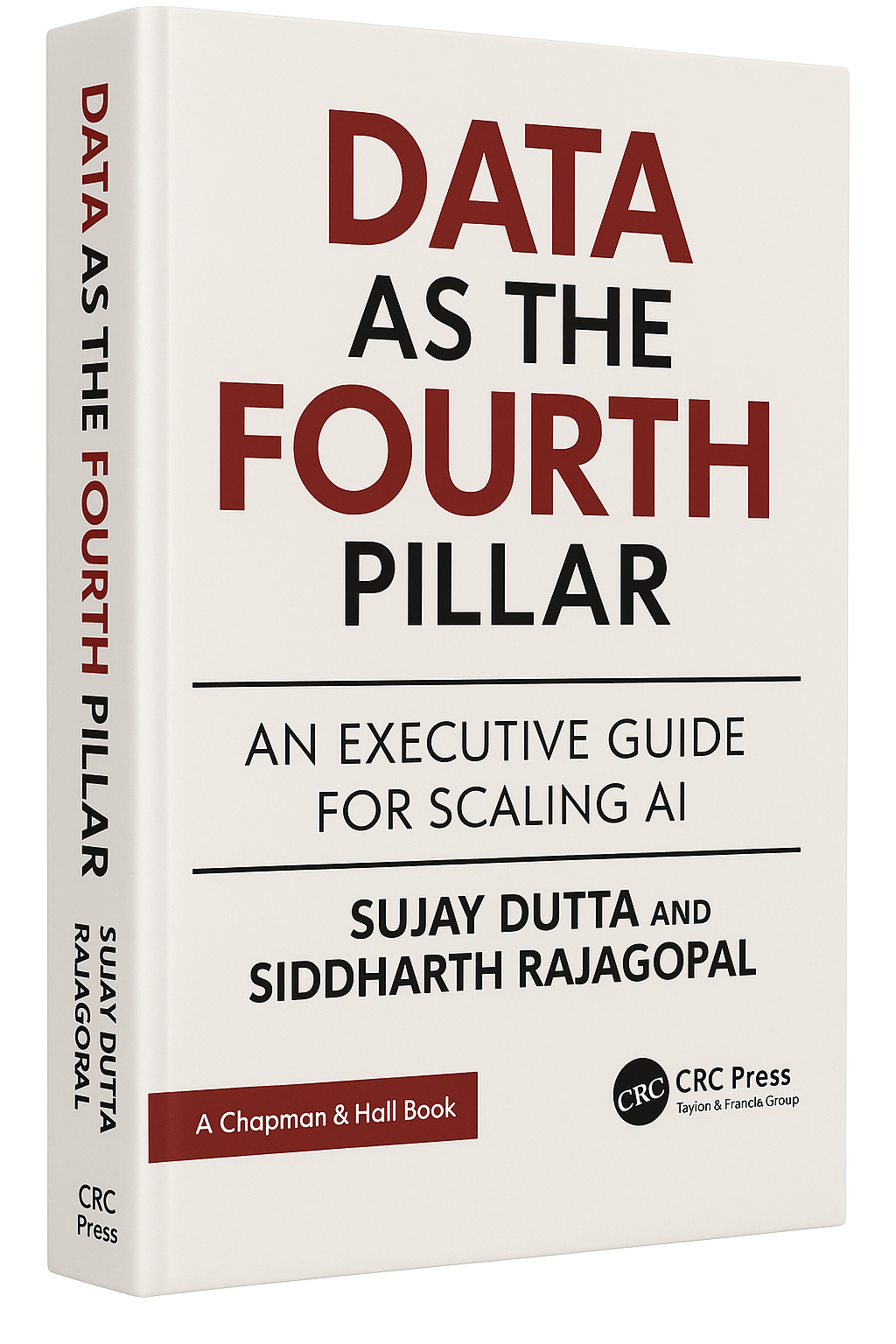
The board-level case for treating data as a first-class strategic asset — with the frameworks, KPIs and maturity model executives need to scale AI before competitors do.
“For three decades, enterprise strategy has rested on people, process and technology. The argument of this book is simple, and overdue: data is the fourth pillar — and the ones who treat it as such will scale AI. The rest will spectate.”
This book reasons why data should be the fourth pillar for every enterprise — alongside people, processes and technology. It gives boards, CEOs, and CxOs a working understanding of why and how to treat data strategically: not as IT exhaust, but as a continuously appreciating economic asset.
The argument is laid out in three movements — the Why, the What, and the How — in measurable terms. To capture business impact, the authors introduce two new KPIs: Total Addressable Value through data (TAV) and Expected Addressable Value (EAV), and a Maturity Framework for moving deliberately from descriptive dashboards to a scalable, AI-powered, data-centric enterprise.
A practitioner's case study by Rüdiger Eck (AUDI AG) grounds the frameworks in production-floor reality — what works, what doesn't, and what every CxO should ask of their own organisation on Monday morning.
Three audiences. One mandate: stop treating data as a back-office cost centre and start running it as the asset it has quietly become.
Be the data champions. Provide sponsorship and strategic leadership to enable the enterprise to derive long-term value through the data pillar.
The CDO's North Star: enable every stakeholder to enhance their business outcomes by leveraging data as a strategic asset.
CIO/CTOs, COOs, CHROs and leaders across functions create the flywheel — enabling the data pillar and benefiting from it.
A three-dimensional way to read data intensity: Quality, Compliance, Speed. Different initiatives need different mixes — get the mix wrong and AI stalls.
An agile data delivery framework that lets the data pillar serve data consumers at the speed they actually need — not the speed your data warehouse can manage.
Most enterprises measure data by how much they store. The book proposes measuring it by what it can earn.
Assess where you are. Set strategic goals. Progress systematically toward a scalable, AI-powered, data-centric enterprise.
Rüdiger Eck details Audi Production's journey: on-the-ground feedback on what works, what doesn't, and the practical lessons every operator navigating similar terrain should expect to learn — the hard way, or from this chapter.
“Without a strategic approach to data, AI initiatives fall flat. The book connects executive vision with operational reality.”
“”
A short-form podcast where the authors and a rotating cast of operators interrogate the ideas in the book — one episode at a time.
We're doing interviews at Big Data London 2026. If you'd like to take part, tell us a little about yourself.
Thank you. We'll be in touch ahead of the show.

"Bridging the gap between production and IT" — a working operator's read on what it actually takes to make a data pillar real on a factory floor that doesn't stop for transformation programs.